Evidence and Citations in AI Outputs: Why “Show Your Work” Matters in Corporate Work
If an AI system influences hiring or purchasing decisions, you need outputs you can verify. This post explains what “show your work” looks like operationally and what to ask vendors during evaluation.
2026-02-26 · 5 min read
What this is
A practical guide to “evidence-linked” AI outputs—what they mean, why they matter, and how to evaluate them in corporate work.
Small description
If an AI system influences hiring or purchasing decisions, you need outputs you can verify. This post explains what “show your work” looks like operationally and what to ask vendors during evaluation.
AI is getting embedded in decisions that matter: screening candidates, summarizing interviews, comparing vendors, drafting justifications, and assembling compliance packets. The problem isn't that AI is “wrong” sometimes—it's that many AI outputs are unverifiable. A confident paragraph with no trace back to source material is not a decision artifact. It's a draft.
“Show your work” changes the posture from trust to verify. It makes review faster, reduces rework, and gives you something defensible when a stakeholder asks, “Why did we do this?”
What “evidence-linked” means in practice
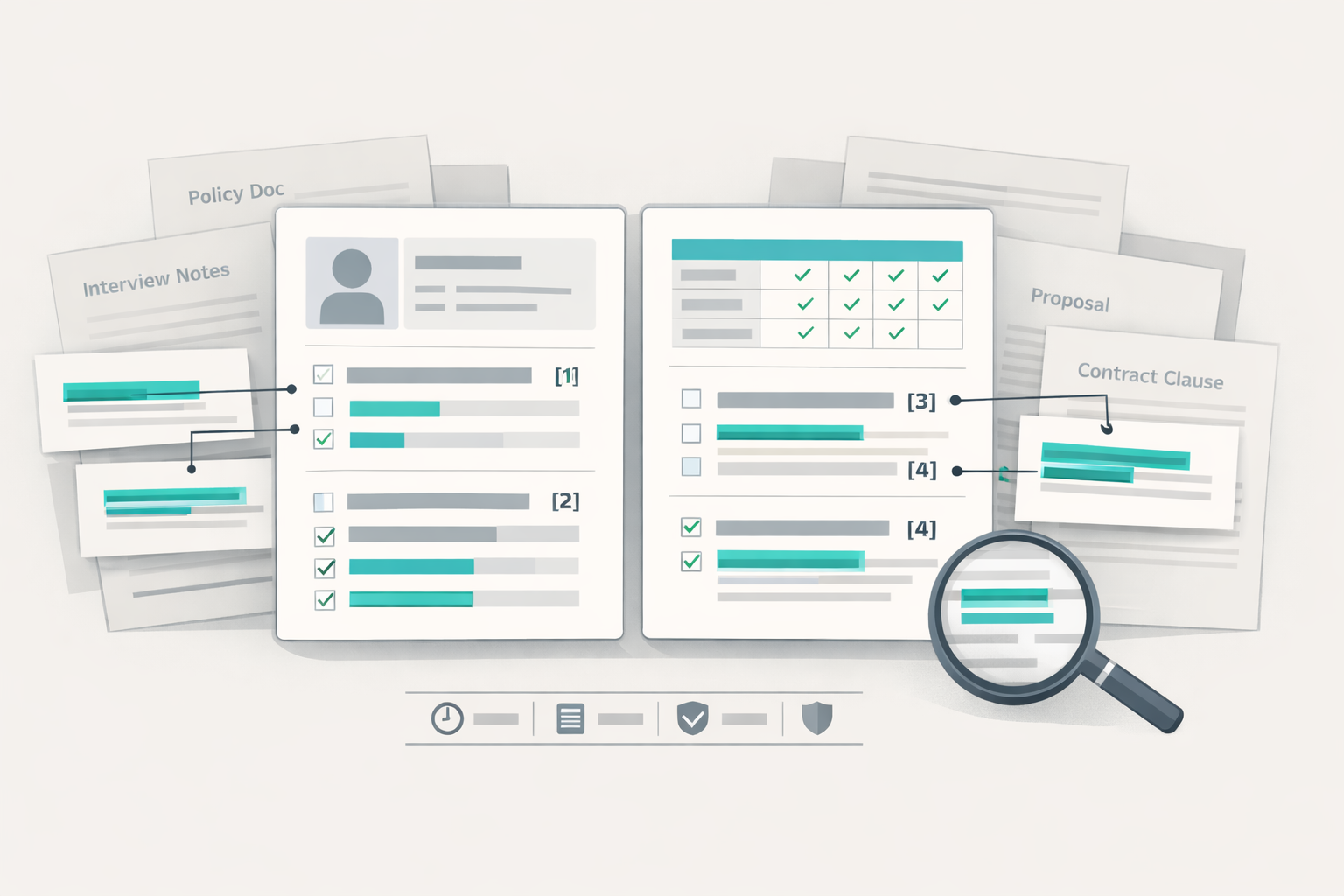
An evidence-linked AI output is one where a reviewer can quickly answer:
- Where did this claim come from? (source file + location)
- What exactly did the source say? (quote/snippet)
- What version of the source was used? (timestamp/hash/version ID)
- What steps produced the output? (prompt/context, tool steps, model/version, parameters where relevant)
In practice, evidence-linking usually looks like:
- Inline citations like [RFP.pdf p.12] or [InterviewNotes_2026-02-10 §3]
- Click-through to the source chunk (with access controls)
- A short quoted excerpt next to the claim
- An audit log of retrieval + transformation steps
Without those, teams end up re-reading entire documents to validate a single sentence—or worse, they don't validate.
Why it matters in business tasks
When AI supports decisions that affect stakeholders, compliance, or spend, outputs need to be verifiable. Evidence-linked results reduce cycle time and increase defensibility. For example, in document-heavy workflows like procurement—RFPs, proposals, security questionnaires, contracts, SOC reports, and exception memos—evidence-linking looks like this:
- Vendor comparisons: Every score should map to a proposal section or evidence item (e.g., “data retention: Proposal p.18; DPA clause 6.2”).
- Security/compliance sign-off: Claims like “supports SSO” or “meets retention requirements” must link to validated docs—otherwise you create downstream risk for security, legal, and audit teams.
- Decision records: When challenged later (“why this vendor?”), you want an evidence-backed narrative, not a retrospective reconstruction.
A useful mental model: if a human can't reproduce the answer from the cited materials in a few minutes, the AI output is not production-grade.
Compliance is moving toward traceability
Regulators and standards bodies are converging on a theme: for higher-risk uses, organizations should be able to trace, document, and monitor AI-supported decisions.
- The EU AI Act classifies certain employment-related uses (e.g., recruitment/selection) as high-risk.
- High-risk obligations emphasize logging/traceability and documentation.
- The EU's official timeline indicates that many high-risk rules (including Annex III systems) apply starting 2 August 2026.
- Frameworks like NIST's AI RMF and ISO/IEC 42001 also push organizations toward documented governance and accountable use.
You don't adopt evidence-linking to “check the compliance box.” You adopt it because it's the only scalable way to keep humans meaningfully in the loop.
TenderMind POV
At TenderMind, we treat “citations” as more than a UI feature. We treat them as the unit of governance.
- Agent kits: An embedded agent can draft structured outputs (e.g. questions, rubrics, evaluations), but every mapping is tied to the source documents and policy text (with snippets). Reviewers can see why an output exists and what it's anchored to.
- Procurement evaluations: Our workflow pattern is “claim → evidence → decision.” When summarizing vendor responses, we preserve evidence links back to proposal sections, SOC excerpts, and contract clauses—so legal/security can review efficiently.
- Compliance and reporting: For audits, we generate evidence-linked narratives (e.g., “control implemented” statements) that point to policies, tickets, or reports, rather than producing a polished paragraph with no trail.
This is why we build Platform Workflows for document-heavy decisions and Embedded Agents that run inside enterprise AI environments—so evidence handling, access control, and audit logs live where your governance already is.
Practical checklist: evaluating “show your work” in AI tools
Use these questions in AI tool evaluations:
- Citation granularity: Can it cite exact page/section/paragraph (not just “from the handbook”)?
- Quoted excerpts: Does each key claim include a snippet reviewers can read instantly?
- Source integrity: Are citations tied to immutable versions (hash/version ID + timestamp)?
- Audit log: Can you export who asked what, what sources were retrieved, and what the system returned?
- Access controls: Do links respect document permissions (no leaking restricted files)?
- Conflict handling: Can it show competing evidence (e.g., two clauses that disagree) instead of picking one silently?
- Hallucination controls: What happens when evidence is missing—does it say “not found” or fabricate?
- Operational fit: Can you embed this into existing workflows (ATS, contract repository, GRC) without copy/paste sprawl?
Decision rule (fast)
- If the output influences a hiring shortlist, compensation band, vendor award, or compliance assertion → require evidence links.
- If it's brainstorming or drafting internal language → citations are helpful, but not mandatory.
What we're exploring next
We're working on patterns that make evidence-linking feel effortless: automatic decision records that bundle outputs, citations, reviewer sign-off, and change history into a single “packet” you can hand to audit, legal, or leadership without rework.
If you want, we can share a lightweight evaluation checklist you can run against any AI tool in under an hour—and map the results to your governance requirements.
Evaluate AI tools with evidence in mind
Want a lightweight checklist to run against any AI tool? We can share one and map it to your governance requirements.